Collect the questions your website should answer
Start with the language people use when asking about your service. Note their task, location if relevant, constraints, and the details they compare. Avoid starting with a long list of loosely related keywords that your business cannot meaningfully answer.
Read the fuller explanation
Group questions by purpose. A service page can explain scope and suitability; a guide can explain how to prepare or choose. Give each planned page a clear job. If two pages answer the same question with almost identical text, consider combining them.
Write a page a person can use
Use a descriptive page title and a heading that says what the page covers. Explain the service in ordinary language, then add the details needed to make a decision. Use headings to organize the answer instead of repeating a search phrase in every paragraph.
Read the fuller explanation
Write the search description as an honest summary, not a promise of a result you cannot guarantee. Link to related services or guides where the next question naturally arises. A reader should know what they will find before following the link.
Prepare a technical review brief
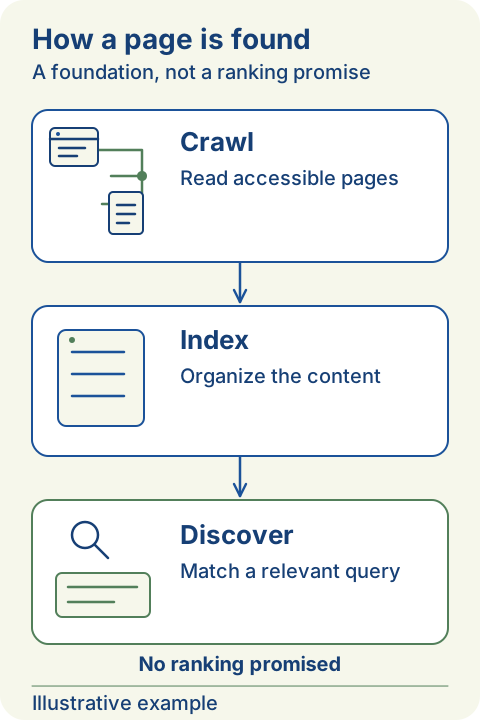
Ask whoever maintains the site to check that important pages are reachable, that intended public pages are not accidentally excluded from search, and that old links have a sensible destination. Include phone usability and image loading in the review.
Read the fuller explanation
For a multilingual site, ask for a review of language-specific URLs, canonical URLs, and language alternates. Each translation should answer the same underlying need in natural language. These are checks to discuss with the implementation team, not a promise that a page will be indexed or ranked.
Review questions and evidence after launch
Record the changes you make and agree what you want to learn. When search reporting is available, review which queries lead to which pages and whether those pages answer the intended question. Compare equivalent periods and note other changes such as campaigns or seasonality.
Read the fuller explanation
Look beyond visits to relevant inquiries and the questions people still ask. A page with little traffic may need a clearer purpose, stronger content, or more time; the count alone does not identify the cause. Prioritize one useful improvement and review it before expanding the plan.
Before your next conversation
- Collect questions from actual sales or support conversations.
- Assign one main purpose to each important page.
- Write specific titles, headings, and honest summaries.
- Ask for a technical and multilingual URL review.
- Agree on review signals without guaranteeing rankings.